
Forwarded this in an email? Subscribe for all things bendy here:
A few weeks ago I reposted an infographic about a new study that claims to debunk the popular book on trauma: The Body Keeps the Score by Bessel van der Kolk. The book posits that trauma lives on in our tissues, particularly the fascia, causing chronic pain and tightness that can be “released” only by body-based therapies.
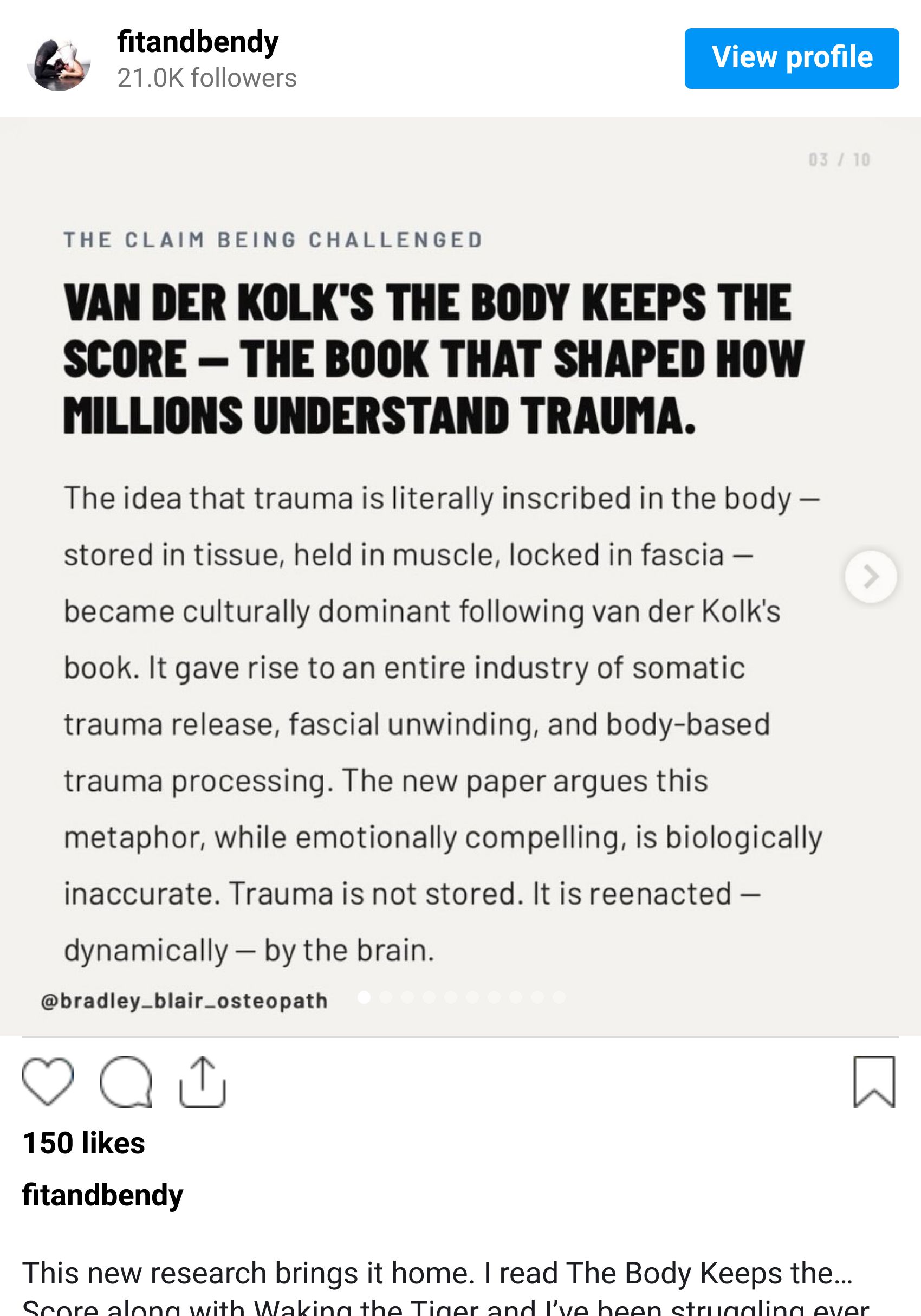
Pushback against van der Kolk’s book isn’t new. Since the book was published in 2014 other professionals in the field have criticized him for treating correlation as causation and cherry-picking the research. I admit that I found the book repellent in it’s demeaning depictions of victims of violence, particularly women and girls, and its claim that trauma changes us forever, negating our power to heal.
For these reasons I was happy to see another evidence-based leg sweep of van der Kolk’s work, but the post did get pushback from some folks, particularly those whose work centers on fascial release as a treatment for chronic pain and tightness.
Then an issues of Dr Linda Bluestein’s Bendy Body newsletter popped up into my inbox and I knew I had to do another post to unpack the nuance in this controversy. As always, an appealing click-bait headline doesn’t tell the full story so I’m writing a newsletter about it, for all of you sitting at home wondering about pain and fascia.
Pain is in the Brain, Not the Body
The study I mentioned in the repost, lead by British neuroscientist Karl Friston, cites current research revealing that trauma and pain do not result in physical changes to our tissues. Rather trauma changes the way our brain responds to stimulus, increasing the probability that it will interpret otherwise harmless signals as dangerous. This makes our brains hyper-vigilant, narrowing our range of focus and making small things feel overwhelming.
A hypervigilant brain is looking for pain, and since the brain decides whether a sensation is painful or not, it will likely find it. It also wants you to be prepared for disaster—increasing muscle tone and elevating stress hormones like epinephrine and norepinephrin. This can have a profound effect on tension and sensation, leading to the impression that our body is holding our trauma.
Certainly when I work with clients who are experiencing chronic tightness, attempting to release those muscles can be a highly emotional experience. There is no doubt that somatic work is a powerful tool, one that should be approached with respect and as much good research as possible since the things we do to our bodies zap right into our brains, constantly manipulating our neural map and affecting our brain’s decisions about safety, pain, and movement.

What’s Fascia Got to Do With It?
Just because trauma isn’t stored in our fascia does not mean that we can ignore it, or that people who work with fascia don’t have an important role to play in addressing chronic pain and tightness. Fascia is not just an inert scaffolding for our organs and muscles, it is a magnificent, complex communication system that deserves attention.
Dr. Bluestein’s newsletter is a favorite of mine, recommended to any of you who have or work with hypermobile bodies. She is at the forefront of research and care in the world of hypermobility and HEDS and has been a great resource for myself and many of my clients. So when she dropped a newsletter about the role of fascia in understanding the hypermobile body I was delighted.
While fascia may not “store” pain and trauma, it is part of how pain and tightness show up in the body. While it was once thought that fascia was simply a web of collagen making up the tendons, ligaments, and sacs that hold our muscles and organs together, in recent years it’s been revealed to be so much more complex.
Fascia is jam packed with sensory neurons that are constantly feeding the brain information about our body’s position (proprioception), muscle tone, and sensation. This means that issues with fascia can either decrease the flow of important information, or increase signaling that could trigger a pain response in the brain.
Fascia is also home to a newly discovered organ (new to Western medicine at least) called the interstitium. This Radiolab episode discusses the discovery and early findings on the interstitium, which is essentially a series of tiny tubes that runs through the entire body, connecting every part of us. These tubes contain 25% of the body’s fluid, distributing all sorts of important stuff like proteins and hormones that are as essential for signalling as the nervous system.
Finally, fascia woorks to distribute and dampen force throughout our body. It transmits movement patterns, allowing for muscles to coordinate across the body. Fascia is also essential to training strength, power, and plyometrics since it acts as a spring, storing and releasing force to amplify muscular contraction.
Fascia Can Contribute to Chronic Pain, Just Not by “Storing” Trauma
In her newsletter Dr. Bluestein emphasizes the importance of addressing fascia when working with hypermobile people. While fascia may not have a mechanism of “storing” trauma, that doesn’t mean that it can’t have issues that could cause chronic pain and tightness.
In the case of HEDs (Hypermobility/Ehlers-Danlos Syndrome) fascia may be a key part of understanding how seemingly unrelated symptoms are actually connected. People with HEDs often show alterations in their fascial structure with disorganized collagen fibers, reduced interstitium activity, and poor ability to distribute, store, and release force. It also means that the sensory information that the fascia is feeding our brains is not always consistent or reliable, enhancing the brain’s hyper-vigilance and propensity for guarding.
All of this means that fascia can be a significant factor when understanding and addressing chronic pain and tightness. Dr Bluestein recommends a number of physical approaches to improving proprioception, fascial structure, and force distribution that can include gentle manual therapy as well as sub-maximal ROM work, stability drills, and nervous system regulation.
Is this all just Semantics?
No. The stories that we tell about trauma, pain, and tightness matter. Our understanding of the human body is incomplete and ever-changing but it falls on every practicioner, from manual therapists to movement coaches to somatic therapists, to try to be as accurate as possible when working with our clients.
If we tell people that their trauma has forever changed their bodies and they need to excavate it from their flesh, that is a very different message than telling them that their brain has learned to be hyper-vigilant but that there is nothing wrong with them, and their brain can learn different patterns. They are not stuck.
That doesn’t mean that we body people don’t have a vital responsibility when working with clients suffering from chronic pain and tightness, with or without reported trauma. I know that in my battle with chronic pain my body has been an essential partner in reaching parts of my brain that responded to somatic stimulation.
Now, even though I am a movement coach not a somatic therapist, I find that a basic understanding of the relationship between trauma and physical/neurological structures allows me to better work with clients seeking help building strength and mobility through the minefield of chronic pain.
As always, I’d love to hear your thoughts on this subject whether as someone who has experience trauma/chronic pain or as a practicioner. I hope that this newsletter and the resources I’ve shared are helpful.
I’m also trying to grow this newsletter while remaining allergic to marketing. If you enjoyed this and know someone else who would enjoy it too, it would be a great help if you could share it!
Happy Bendings,
Kristina
