
Forwarded this in an email? Subscribe for all things bendy here:
I’ll never forget the moment I felt my chronically tight hip flexors relax for the first time. I was driving home from a Pilates session in 2010 and I suddenly felt my hips sink into the car seat. It was like a deep sigh of relief that echoed from my pelvis all the way up my spine and made me so light-headed I had to pull over. I found tears on my cheeks.
I immediately texted my Pilates mentor Jenn Berry, to whom I credit this miracle.
“My hip flexors relaxed!!!!! I’ve never felt like this before in my life!!!!” I wrote, though probably with more exclamation points and all caps, when I had finally stopped weeping.
Over the last few months my newsletters have been focused on how the brain creates chronic tightness when it isn’t confident in the body’s ability to move safely, a strategy called muscle guarding. I’m bringing us back to this moment in my life because this is when I first experienced first-hand how using the right tools can get lifelong tightness to finally let go.
A Lifetime of Stretching Only Made Me Tighter
Prior to this moment I had been stretching my hip flexors religiously for decades. I started in ballet and gymnastics as a little tyke and was always the bendy noodle who got to do all the flexibility stuff and couldn’t jump (now I know it’s because I have no stretch reflex). But even at 8 years old I started having psoas spasm that would knock me to the floor. Back then the coaches and doctors had no idea what to do with me.
As a contortionist my hips were my weakness, limiting movements like triple fold and catch ankles that were otherwise accessible. The only way I could get them to stretch out was by doing a crazy pose where I would tuck my foot under the back of my head and hold it there in a lunge for 60 seconds. Even after that, the relief was fleeting, and I would be even tighter after I cooled down.
Only the most extreme stretches worked on me, and even then the relief was very short-lived and the tightness came back like an ice floe every time.
So what changed? Why did my hips suddenly decide to cooperate after years of doing battle?
It wasn’t from stretching. You can do 1,000 lunge stretches and still have hip flexors of steel.
After years of over-stretching in gymnastics, dance, martial arts, and contortion training, my hips were held together by hope and a tiny bit of gristly connective tissue. Hypermobility had taught me how to use my flexibility instead of strength to get through my workouts so, although I appeared strong, I had terrible proprioception and very little ability to support the expansive range of motion I had developed from a lifetime of stretching.

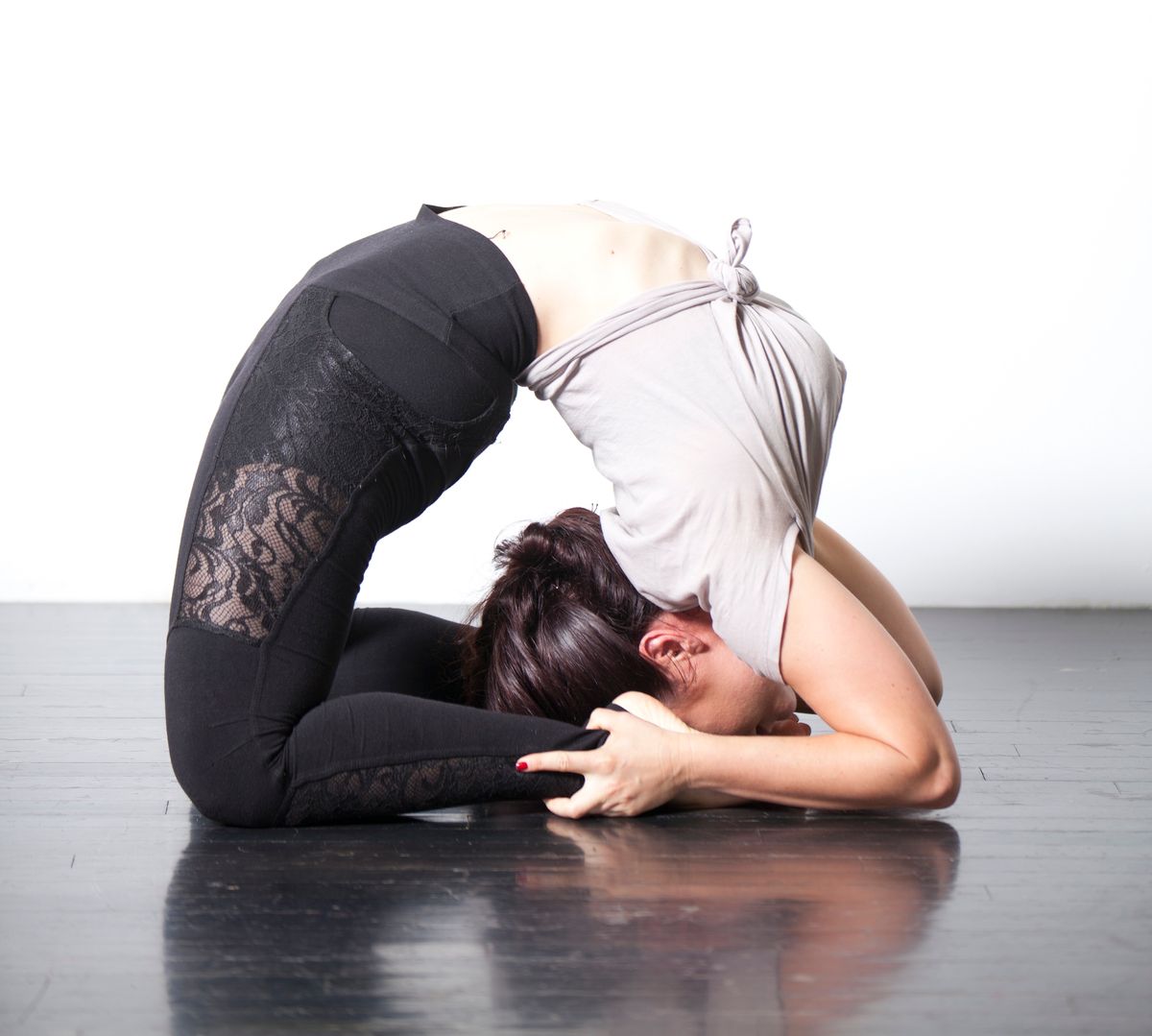
This girl in this deep flexibility pose (circa 2009) still had hip flexors so tight that they would spasm and cause horrible pain. Just because you are generally flexible doesn’t mean you don’t suffer from chronic tightness.
Are You Floppy-Tight Too? It’s a Thing!
It is very common for the most flexible people to also have areas that are spectacularly tight. When our passive range of motion is much greater than our active range of motion we have a large swathe of range where we can hang out, but we can’t properly feel or control our bodies.
If you remember the brain’s homunculus map, you know that a blurry map makes the brain feel very nervous. This passive vs active discrepancy leads to big blurry areas and massive brain insecurity, generating very enthusiastic muscle guarding.
There are certain muscles that are more likely to be enlisted in muscle guarding than others. The hip flexors are very high on the list (specifically the rectus femoris, tensor fascia latae, and iliopsoas). Other usual suspects include calves, hamstrings, pectoralis muscles, scalenes (the front of the neck), and upper trapezius. The brain chooses its muscles based on where it feels the most instability, how you hold your body, how you breathe, and how you move.
So if you have ever wondered how your body became so floppy-tight, I hope that this helps you make sense of a very frustrating predicament.
I also want to give you hope!
Stability Works When Stretching Fails
Over the last few weeks I have covered a few of my favorite ways to address muscle guarding by feeding the brain good quality information that helps to bring the homunculus into focus. I covered some of my somatic movement practices and overcoming isometrics, two great tools I employ in both my coaching work and my own workouts.
But back when I was doing Pilates with Jenn we did something that was both simple and very challenging for me: she made me reduce my range of motion.
I know I talk a lot about the importance of end range strengthening, and I don’t retract any of it. But for my hypermobile hotties and anyone who has spent a lot of time at end range, sometimes the midpoint of a joint needs attention too.
Jenn was the first person who talked me into pulling back on my range of motion and focusing on control. She refused to be impressed by my amazing oversplits and made me stay in a very small midrange for all of my exercises, emphasizing joint isolation and alignment.
Pilates is great for this kind of work, especially if you have an instructor with eagle eyes who can tell when you are letting your back arch or your pelvis rotate to cheat yourself out of building that deep stability.
I actually learned how to engage my deep hip flexors—the iliopsoas—and start to build some useful strength. I was able to stabilize my spine and rib cage and change my breathing pattern which helped my pelvic floor chill out a bit. I could really feel my body in these mid ranges that I was used to just racing through in order to get to that satisfying stretch position.
That was 16 years ago, and there have been a lot of ups and downs and changes since then, but I can say that my hip flexors have never gone back to being chronically tight. Every time I feel them gearing up for a good spasm I employ the techniques I know build that stability and give my brain the reassurances that it needs.
The moral of this story isn’t that you must do Pilates. This was my path, but there are many, many paths. I just wanted to share with you my own experience of feeling, for the first time in my own body, how stretching isn’t necessarily the remedy for chronic tightness and to reassure you that even if you have been stretching for years without relief, it’s not because there is something wrong with your body.
Your body doesn’t need to be forcefully beaten into relaxation, your brain just needs to trust your body a little more.
I promise that the work of slowing down, tuning in, lightening up, and whispering into the darkness of your nervous system is all worth it.
Happy Bendings,
Kristina
Want to go deeper?
Further reading:
Tight Hip Flexors Despite All Your Lunge Stretches? — the companion piece to this post
It's Not Your Age, It's Your Nervous System — start here if you're new to the series
The Homunculus in Your Head — And Why It Matters for Flexibility — understanding your brain's body map
Overcoming Isometrics: How to Reconnect Your Brain and Body for Better Flexibility — the practical tool that helps rebuild neural maps
Strong AND Flexible: Understanding End-Range Strengthening — the next step once your brain trusts your body again
Want to work on this in person?
This November I'm co-teaching a week-long flexibility and mobility retreat in Oaxaca, Mexico with Kerri Krisinski. Hip flexors, neural mapping, somatic movement — all of it, in your body rather than on a page together with a small group of wild, feral women in the jungle by the pool.
For women and femme-aligned folks over 45 who refuse to let age and societal BS write the story of what their body can do.
Try it at home first
Get a free month of Fit & Bendy flexibility videos — including hip mobility and neuromuscular sessions designed to help you find that deep stability.
Know someone who's been stretching their hip flexors forever with nothing to show for it?
Share this newsletter with them and I will be forever grateful!
👉 {{rp_refer_url}}
Get the newsletter
Every week I write about the science of flexibility, mobility, and movement — for all levels. Subscribe free here.
